
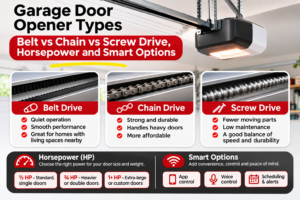
If your garage door opener is getting old, loud, or you are installing a new door, picking the right opener type makes a real difference in day to day use. A good opener runs quietly, lasts over a decade, and keeps your door moving smoothly. Here is a full breakdown of how the main opener types compare, so you can make the right call for your home.
How a garage door opener actually works
Every garage door opener uses a motor mounted at the back of the garage to drive a trolley along a rail. The trolley connects to the door through an arm, and as the motor turns, it pulls the trolley forward or back, opening or closing the door. What changes between opener types is the mechanism that moves the trolley along that rail: a belt, a chain, or a threaded screw. That one difference drives most of the noise, cost, and maintenance differences below.
Belt drive openers
Belt drive openers use a reinforced rubber belt, often with steel or fiberglass cords inside it, to move the trolley. They are the quietest option on the market, which makes them a strong fit for garages attached to bedrooms, home offices, or living spaces where noise matters.
Pros: Very quiet, smooth operation, long lifespan, minimal vibration transferred to the house structure.
Cons: Higher upfront cost than chain drive, belt can wear over many years of heavy use.
Best for: Attached garages, homes with bedrooms above or next to the garage, anyone prioritizing quiet operation.
Chain drive openers
Chain drive openers use a metal chain, similar to a bicycle chain, to pull the trolley. They are the most common and most affordable option on the market, and they handle heavy doors well.
Pros: Lower cost, very strong, handles heavy wood or insulated doors reliably, widely available parts.
Cons: Noisiest of the three options, metal on metal contact creates vibration and rattling over time.
Best for: Detached garages, homes where the garage is far from living spaces, budget conscious installs.
Screw drive openers
Screw drive openers move the trolley along a threaded steel rod that rotates to drive movement forward or back. With fewer moving parts than belt or chain systems, they need less adjustment and maintenance over time.
Pros: Fewer moving parts, less maintenance, consistent and smooth motion, mid-range cost.
Cons: Performance can be affected by extreme temperature swings, which can cause the lubricant to thicken in colder weather.
Best for: Homes with stable garage temperatures, anyone who wants low maintenance without the full cost of belt drive.
Jackshaft and wall mount openers
For garages with limited ceiling space, high ceilings, or exposed rafters, a jackshaft opener mounts on the wall beside the door instead of overhead. This frees up ceiling space for storage and works well with insulated or high lift doors. These tend to cost more and usually require professional installation to set up the torsion bar connection correctly.
Horsepower and motor strength
Opener motors are rated in horsepower, typically between 1/3 HP and 1.25 HP, or in newer DC motor models, by comparable torque ratings. A single car, lightweight door usually needs less power, while a double car, insulated or heavier wood door needs a stronger motor to avoid strain and early motor failure. An undersized motor working overtime is one of the most common causes of premature opener burnout.
Smart vs standard openers
Most openers sold today, across all three drive types, are available with smart features: phone app control, real time alerts when the door opens or closes, and compatibility with home automation systems. Standard openers without these features are usually less expensive but only offer a wall switch and physical remote. For homeowners who want to check on their garage while away, or get an alert if the door was left open, a smart opener is worth the modest price difference.
Comparison at a glance
| Type | Noise Level | Relative Cost | Maintenance | Best For |
|---|---|---|---|---|
| Belt Drive | Quietest | Higher | Low | Attached garages, bedrooms nearby |
| Chain Drive | Loudest | Lowest | Moderate | Detached garages, heavy doors |
| Screw Drive | Moderate | Mid-range | Low | Stable temperature garages |
| Jackshaft | Quiet | Highest | Low | High ceilings, limited space |
Which one is right for you
For most homes in Richmond, Surrey and Vancouver, belt drive openers are the best balance of quiet operation and reliability, especially given how many garages here are attached directly to living space. If budget is the main concern, chain drive is a solid, proven choice that has worked reliably for decades. If you want low maintenance and your garage holds a fairly stable temperature year round, screw drive is worth considering. For garages with vaulted ceilings or limited overhead clearance, a jackshaft opener solves the space problem even though it costs more upfront.
Installation considerations
Opener installation is not just about mounting the motor. It involves setting the correct travel limits so the door stops at the right point, calibrating the force sensitivity so the door reverses safely if it hits an obstruction, and aligning the safety sensors near the floor. A poorly calibrated opener is both a safety hazard and a common cause of early wear. This is why professional installation matters, even for homeowners who are comfortable with general DIY projects.
Maintenance tips by opener type
Belt drive openers need almost no maintenance beyond an occasional visual check of the belt for fraying. Chain drive openers benefit from chain lubrication once or twice a year to reduce noise and wear. Screw drive openers need the rail lubricated with the manufacturer recommended grease, especially before winter, to keep the mechanism moving smoothly in colder temperatures.
Signs your current opener needs replacing
Grinding noises, slow response times, the door reversing on its own without an obstruction, visible fraying on a belt, a straining motor sound, or an opener older than 10 to 15 years are all signs it may be time for a new installation rather than another repair.
FAQ
How long do garage door openers last?
Most openers last 10 to 15 years with regular use and basic maintenance. Belt drive units tend to last the longest with the least intervention.
Can I install a new opener on an old door?
Yes, in most cases. A technician will check your door’s weight and spring system first to make sure the new opener is correctly matched and safe to use.
Is a smart opener worth it?
Smart openers add phone control and alerts, which many homeowners find useful for monitoring the garage remotely, especially when away from home for extended periods.
What horsepower opener do I need?
Most single doors need 1/2 HP, while double, insulated, or heavier wood doors usually need 3/4 HP to 1.25 HP for reliable long term performance.
How often should I service my opener?
An annual check of the chain or belt tension, sensor alignment, and force settings keeps most openers running smoothly for years.
Not sure which opener fits your garage? Call (236) 205-2339 for a free consultation.
Related: Garage Door Repair | Garage Door Installation | Richmond Service Area | Surrey Service Area